


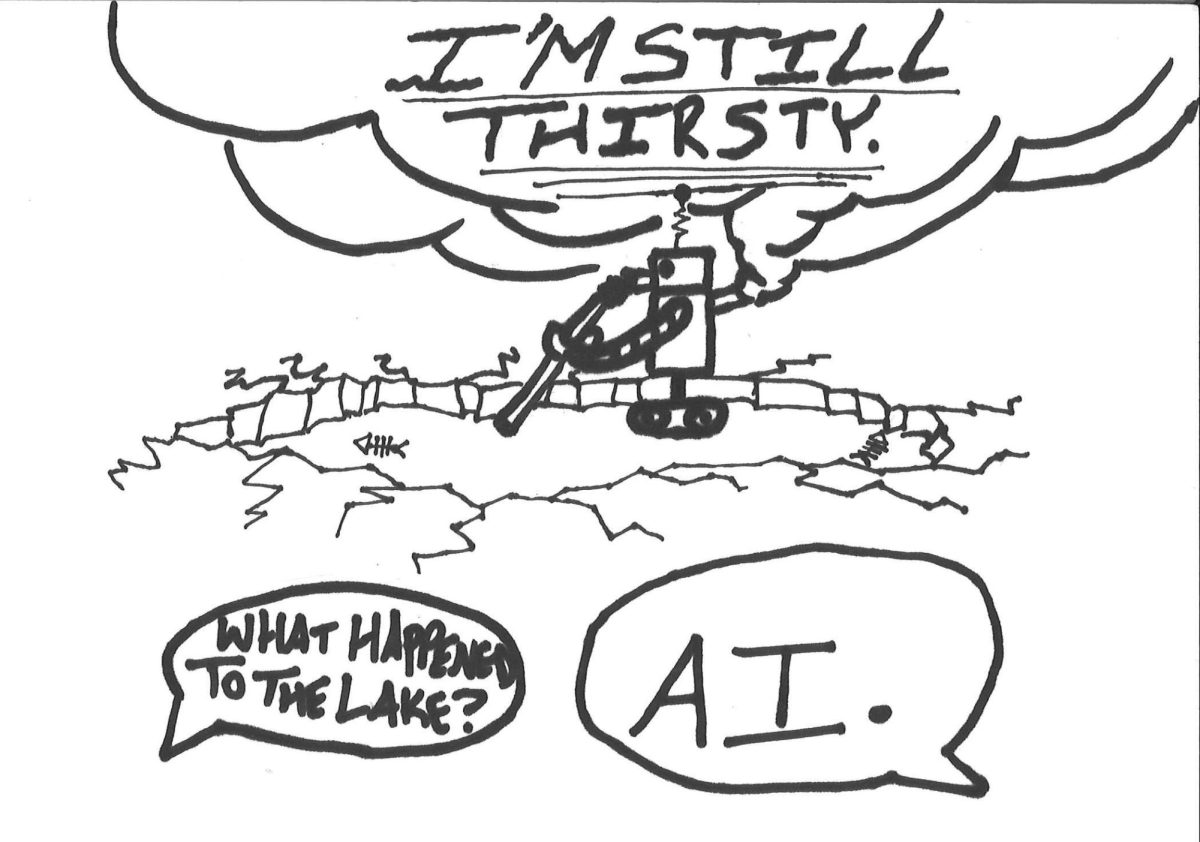
AI data centers are popping up all over the world. They are going to cause more harm than good.
Data centers are not new; they have been around since before the Internet was created in 1983, with the first data centers being established in the 1940s. However, AI has caused an exponential growth in the construction of them. They are popping up in rural areas such as the Joliet Technology Center, being built in Joliet, and can take up between 200 and 300 acres of land.
These data centers are directly impacting human lives by consuming many resources, such as water. According to The University of Alabama at Birmingham, ‘In 2021, just one of Google’s data centers in Oregon used up 355 million gallons of water.’
Another negative is the energy consumption. Inflation is already at a high, and now, according to many reports, such as one from the Citizens Utility Board, we will have to pay higher electricity bills, even though most average Americans do not want the centers in the first place.
Data centers have increased local pollution, which has threatened public health. The University of Alabama at Birmingham also states, ‘AI centers, on top of their energy use from the grid, also employ backup generators in case of grid failure; these diesel generators can release 200 to 600 times more nitrous oxides (NOx) than a natural gas plant while producing the same amount of energy.’
While there could be some positives, like economic growth and job opportunities, when we really step back and look at it, it is not worth the harm that it brings to small communities.
Unfortunately, AI is not going away; it will only expand in the coming years. Companies should focus on implementing eco-friendly initiatives, such as using renewable energy sources and maintaining local water supplies. There has to be more concern for the environment and human life than money-making. It is important to be active in the community by attending meetings, speaking up, and voting. A few data centers are not a problem, but it becomes a problem when they are noticeably impacting environments and communities.